
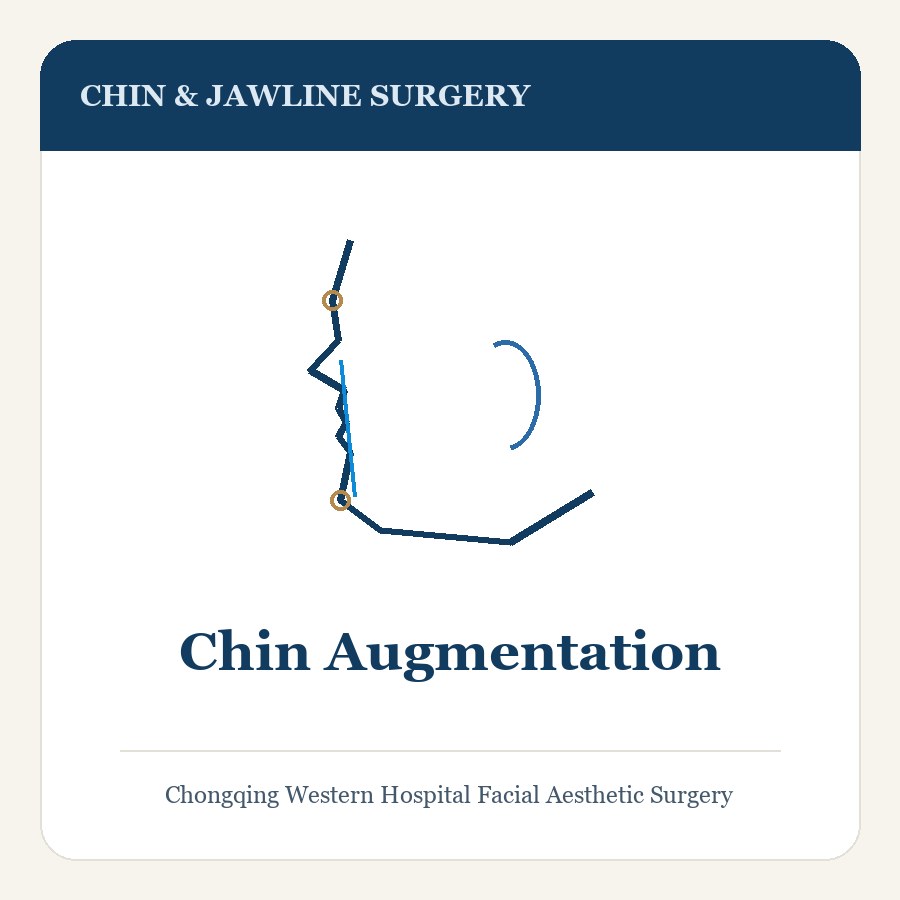
In short. Chin augmentation is surgery that corrects a recessed or short chin with an implant placed on the bone, improving projection and profile balance. The real decision is not whether to augment but with what: a temporary filler, a removable implant, or a bone-cutting genioplasty, which is the only option that changes vertical height or asymmetry.
Key points
- A chin implant improves projection and profile balance in mild-to-moderate deficiency.
- A small chin can be the visible tip of a recessed lower jaw.
- Filler is temporary, an implant is removable, and genioplasty moves bone.
- Genioplasty is the only option that changes vertical height or asymmetry.
- Active infection, uncontrolled diabetes and smoking raise the risk around an implant.
What a chin implant changes
A recessed or short chin quietly weakens the entire lower face: the profile reads as retruded, the jawline loses definition, and the nose can look larger than it is. Chin augmentation corrects that with an implant placed on the bone. It is a small operation whose planning matters far more than its size, and the real decision is not whether to augment but with what: an implant, a filler, or a bone-cutting genioplasty.
The anatomy and the bite
Chin analysis looks at three dimensions, projection, vertical height and width, always against the whole profile, because a chin is only small relative to the nose, lips and neck behind it. The dental bite is examined as well, because a chin that looks small can be the visible tip of a recessed lower jaw. Separating those two situations is the difference between a chin implant and orthognathic surgery, which is a different conversation entirely.
Who does it suit, and when is it the wrong operation?
Implant augmentation suits mild-to-moderate chin deficiency in a person with a stable bite, good general health and realistic expectations. It does not suit severe deficiency, functional bite problems, active dental or jaw infection, uncontrolled diabetes, or smokers unwilling to stop, all of which raise wound-healing and infection risk around a foreign material.
The options compared
Filler adds temporary projection for small deficiencies and previews what augmentation does, then wears off. A solid elastomer implant gives durable projection through a small incision and can be removed or exchanged if plans change. Sliding genioplasty cuts and moves the chin bone itself: it is the only option that shortens, lengthens or re-centres the chin, at the cost of a longer operation and recovery. Many small chins are served well by an implant; vertical and asymmetric problems usually need the bone.
| Option | What it does | Who it suits | What to plan for |
|---|---|---|---|
| Filler | Adds temporary projection and previews augmentation | Small deficiencies | It wears off |
| Solid elastomer implant | Gives durable projection through a small incision | Many small chins | It can be removed or exchanged |
| Sliding genioplasty | Cuts and moves the chin bone | Vertical and asymmetric problems | A longer operation and recovery |
| Severe deficiency or bite problem | Not an implant question | Orthognathic assessment | A different conversation |
| Lax skin blurring the jawline | Not corrected by an implant | A facelift assessment | Staged or separate planning |
The operation, incisions and anaesthesia
The implant is placed through a short incision under the chin, the submental route, or inside the lower lip, the intraoral route, which leaves no visible scar but carries a slightly higher contamination risk. The operation takes under an hour, usually under local anaesthesia with sedation or a light general anaesthetic, and most patients go home the same day.
What surgery can and cannot achieve
An implant reliably improves projection and profile balance and visibly sharpens the jawline and neck angle. It cannot correct a recessed bite, shorten a vertically long chin, or substitute for a facelift when lax skin blurs the jawline. Those need different operations, sometimes staged together with this one.
Recovery, scars and named risks
Swelling peaks in the first days and largely settles in two weeks; the final contour appears over months. The submental scar typically fades to a fine line. Complications are uncommon but named honestly: infection, implant malposition or asymmetry, seroma, temporary and rarely persistent numbness of the lower lip, and the occasional need for repositioning or removal.
Preparation and follow-up
Planning comes from profile photographs and, when the bite is in question, dental evaluation. Sutures dissolve or come out within a week. Follow-up visits at one week, one month and three months track healing; an infected or malpositioned implant is revised early, while cosmetic refinements wait for full healing.
When should surgery be reviewed or deferred?
- Fever, spreading redness, wound discharge, or increasing pain in the first weeks, because infection around an implant needs prompt treatment.
- A wound that separates, an implant edge that becomes visible, or lip numbness that worsens rather than gradually improving.
- Surgery while pregnant, active smoking, or uncontrolled diabetes, which should be deferred until these are addressed.
Sources
Internal links
Frequently asked questions
How do I choose between filler, an implant, and bone surgery?
Filler adds temporary projection for small deficiencies and previews what augmentation does. A solid elastomer implant gives durable projection through a small incision and can be removed or exchanged if plans change. Sliding genioplasty moves the chin bone itself and is the only option that shortens, lengthens or re-centers the chin.
Could a small chin actually be a jaw problem?
Yes, and the distinction matters. The dental bite is examined because a chin that looks small can be the visible tip of a recessed lower jaw. That is a different conversation entirely, pointing toward orthognathic surgery rather than a chin implant.
Where is the incision, and what are the named risks?
The implant is placed through a short incision under the chin, or inside the lower lip, which leaves no visible scar but carries a slightly higher contamination risk. Named risks are infection, implant malposition or asymmetry, seroma, and temporary or rarely persistent numbness of the lower lip.
Risks & Limitations
- Bruising and swelling lasting weeks; after bone surgery, months pass before the final result is visible.
- Scars are permanent. They mature and fade over 6–12 months but never disappear.
- Numbness or altered sensation, which may be temporary or, after bone or nerve work, lasting.
- Asymmetry, under-correction or over-correction; final assessment is made at 6–12 months.
- Infection, bleeding or haematoma, which may need drainage or antibiotics.
- Breathing changes after nasal surgery, which may be temporary or require further treatment.
- Revision surgery carries higher risk and is less predictable than a first operation.
When to Seek Care
- Difficulty breathing or shortness of breath — seek emergency care immediately.
- Rapidly expanding swelling, or a tense, painful, tight area.
- Fever above 38 °C, spreading redness, warmth or pus.
- Bleeding that does not stop with gentle pressure.
- Any sudden change in vision after facial surgery or a facial injection.
References & Further Reading
- American Society of Plastic Surgeons (ASPS) — procedure and safety guidance
- International Society of Aesthetic Plastic Surgery (ISAPS)
- National Institute for Health and Care Excellence (NICE, UK) — relevant guidance
- Cochrane Library — systematic reviews in facial plastic surgery
This page is patient education, not medical advice, and it does not cite individual studies. Discuss your own case with a qualified clinician. To arrange an assessment at Chongqing West District Hospital, see Contact & Consultation.