
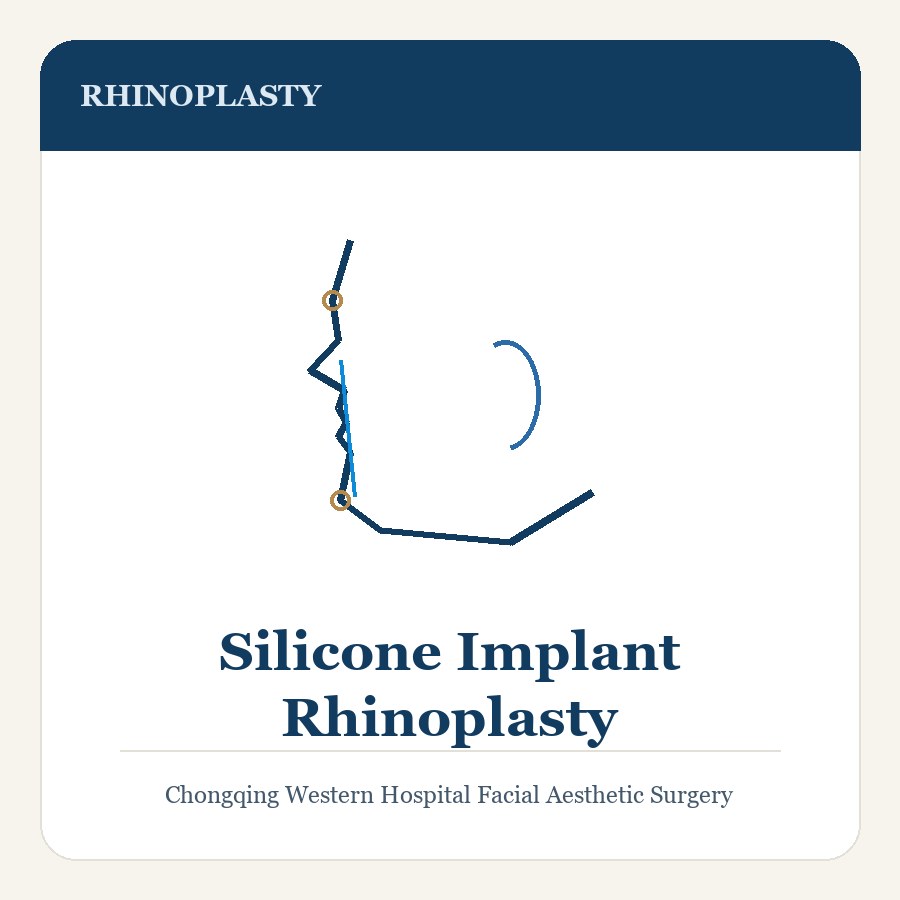
In short. A silicone implant raises a low nasal bridge. It is smooth, solid, and easy to place and remove, which is why it has been used for decades in East Asian rhinoplasty. The same properties explain its characteristic risks: the body forms a capsule rather than growing into it, so the implant can move, contract, thin the skin, and rarely extrude. It suits a moderate bridge raise, not tip projection.
Key points
- Silicone does not integrate; a fibrous capsule forms around it.
- Best for a moderate bridge raise; not for tip projection or very thin skin.
- Capsular contracture can shorten or distort the nose over years.
- Removal is technically straightforward, but the nose may then need cartilage reconstruction.
- Redness, thinning, or a visible edge over the implant needs urgent review.
Why does the body react this way?
Because the implant is smooth and non-porous, tissue never grows into it. Instead the body forms a thin fibrous capsule, and the implant sits as an independent object under the skin. On the bridge, where the skin is thicker and the goal is simple height, this often works well for years. At the tip, where tension is high and blood supply delicate, a solid implant pressing outward is the classic setup for trouble.
Who is it for — and who is it not for?
It suits adults seeking a moderate bridge raise who accept a foreign material and its surveillance, and whose tip needs will be handled with their own cartilage rather than by the implant. It is a poor choice for very thin skin, for patients wanting major tip projection from the implant itself, and for anyone unwilling to accept that a late problem, even years later, may require removal.
How do the materials compare?
| Silicone | ePTFE | Autologous cartilage | |
|---|---|---|---|
| Integration | None; capsule forms | Tissue ingrowth | Full integration |
| Movement | Can move in pocket | Less | None |
| Removal | Technically simple | Harder due to ingrowth | Requires carving/donor site |
| Infection | Usually requires removal | Stubborn low-grade infection | No foreign-body risk |
| Best use | Moderate bridge raise | Bridge, selected cases | Tip and refinement |
The modern compromise for many patients is a silicone or ePTFE bridge with a cartilage tip — never implant material bearing tip pressure.
What happens in surgery?
Pure bridge augmentation is often done through closed incisions inside the nostril, under local anesthesia with sedation or general anesthesia, in under an hour. When combined with tip cartilage work, the open approach and general anesthesia are usual.
What can it achieve — and what can it not?
It reliably raises the bridge by a planned, modest amount with a predictable early result. It cannot refine the tip, and it should not be asked to: implant-driven tip projection is the principal cause of skin thinning and extrusion. It also cannot be judged finally at one month — capsule formation and settling take longer, and late changes happen.
What are the risks and the removal question?
The recognised complications are specific to a non-integrating implant: mobility within the pocket, deviation if the pocket is asymmetric, capsular contracture that can pull the tip upward over years, skin thinning and redness over an edge, and extrusion, which is rare but demands urgent removal. Infection around silicone usually requires removal to resolve. Removal is technically straightforward because the capsule allows it, but the nose afterwards may need cartilage reconstruction, which is a larger operation than the original augmentation.
When should you seek surgical review?
- The skin over the implant turns red, shiny, thin, or tender, or the implant edge becomes visible.
- The nose changes shape progressively, the tip drifts upward, or the implant moves when touched.
- Fever, swelling, or discharge appears over an implant at any time, even years later.
Sources
Internal links
Frequently asked questions
Who is a poor candidate for a silicone implant?
It is a poor choice for very thin skin, for patients wanting major tip projection from the implant itself, and for anyone unwilling to accept that a late problem, even years later, may require removal. It suits a moderate bridge raise in an adult who accepts a foreign material and its surveillance.
What is capsular contracture and why does it matter?
Because silicone is smooth and non-porous, the body forms a thin fibrous capsule around it rather than growing into it. That capsule can contract over years, shortening or distorting the nose and pulling the tip upward. It also allows the implant to move within its pocket and, rarely, to extrude.
Can the implant be removed later if needed?
Removal is technically straightforward because the capsule allows the implant to be slipped out, but the nose afterwards may need reconstruction with cartilage, which is a larger operation than the original augmentation. Infection around silicone usually requires removal to resolve.
Risks & Limitations
- Bruising and swelling lasting weeks; after bone surgery, months pass before the final result is visible.
- Scars are permanent. They mature and fade over 6–12 months but never disappear.
- Numbness or altered sensation, which may be temporary or, after bone or nerve work, lasting.
- Asymmetry, under-correction or over-correction; final assessment is made at 6–12 months.
- Infection, bleeding or haematoma, which may need drainage or antibiotics.
- Breathing changes after nasal surgery, which may be temporary or require further treatment.
- Revision surgery carries higher risk and is less predictable than a first operation.
When to Seek Care
- Difficulty breathing or shortness of breath — seek emergency care immediately.
- Rapidly expanding swelling, or a tense, painful, tight area.
- Fever above 38 °C, spreading redness, warmth or pus.
- Bleeding that does not stop with gentle pressure.
- Any sudden change in vision after facial surgery or a facial injection.
References & Further Reading
- American Society of Plastic Surgeons (ASPS) — procedure and safety guidance
- International Society of Aesthetic Plastic Surgery (ISAPS)
- National Institute for Health and Care Excellence (NICE, UK) — relevant guidance
- Cochrane Library — systematic reviews in facial plastic surgery
This page is patient education, not medical advice, and it does not cite individual studies. Discuss your own case with a qualified clinician. To arrange an assessment at Chongqing West District Hospital, see Contact & Consultation.