
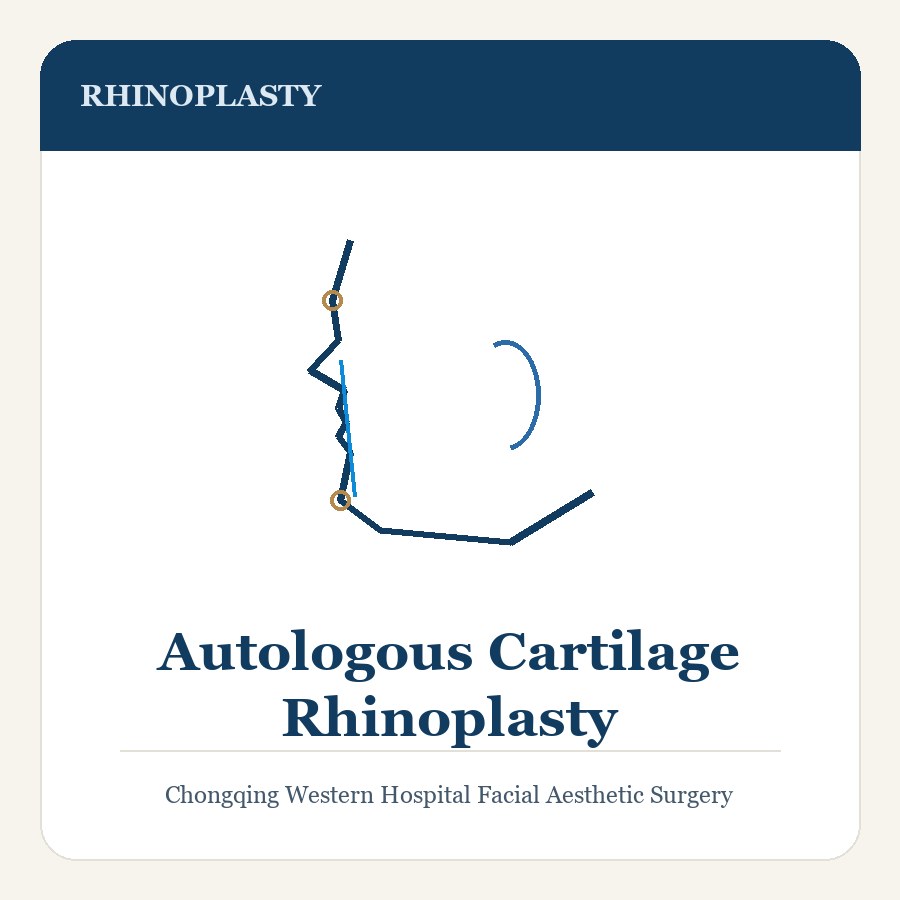
In short. Autologous cartilage rhinoplasty builds the nasal framework from the patient's own cartilage. Septum is the first choice: straight, strong, harvested through the same incision, but limited. Ear cartilage is plentiful and curved, good for tip contour. Rib offers volume and strength for major reconstruction, at the cost of a chest scar, a small pneumothorax risk, and a tendency to warp.
Key points
- Living tissue avoids implant contracture, thinning, and extrusion.
- Septum first; ear for contour; rib when volume is the problem.
- Rib brings a chest scar, pneumothorax risk, and warping.
- Donor-site consequences are part of the bargain.
- Final nasal judgement waits a year.
Which cartilage source, and why?
| Septal | Ear (conchal) | Rib | |
|---|---|---|---|
| Supply | Limited | Plentiful | Large |
| Shape | Straight, strong | Curved | Strong, can warp |
| Best use | Bridge and support | Tip contour, camouflage | Major reconstruction |
| Donor scar | None external | Hidden behind ear | Chest |
| Main risk | Septal perforation (small) | Ear ache, contour change | Pneumothorax, warping |
The hierarchy is practical: septum first, ear for contour, rib when volume is the problem.
Why use the patient's own cartilage?
The nose needs material firm enough to hold shape under skin tension, yet carvable and biologically quiet. Cartilage meets that better than any synthetic: it is what the native framework is made of. Because the tissue is living and becomes part of the nose, it avoids the long-term implant risks of contracture, thinning, and extrusion — at the cost of a second surgical site and more operating time.
Who is it for — and not for?
It suits patients needing tip support and definition, those with thin skin over the bridge in whom an implant edge would show, those who have reacted to or rejected implants, and most revision cases. It may not suit someone unwilling to accept a donor-site scar, someone whose cartilage sources are exhausted, or a patient wanting the simplest operation for a modest bridge raise.
What does surgery achieve?
It can rebuild an entire framework — bridge, tip, support — and tolerates thin skin and revision planes better than implants. It cannot be carved to infinite precision: edges can show through very thin skin, small resorption occurs in a minority of grafts, and rib grafts can bend despite every precaution.
What is recovery like?
Nasal recovery mirrors other structural rhinoplasty: a week of splinting, two weeks to social comfort, months of settling. The ear aches for days and must not be slept on; the rib site is sore for one to two weeks and limits heavy lifting for about six weeks. Final nasal judgement waits a year.
What are the risks?
Scars are permanent but placed to be hidden. Graft complications include warping, partial resorption, visibility, and asymmetry; donor complications include ear contour change, chest scar thickening, and rarely pneumothorax. Septal harvest carries a small risk of septal perforation. Revisions are sometimes needed and are planned no earlier than a year.
When should a surgical review happen?
- A graft visibly bends, hardens, or becomes tender, or the nose changes shape progressively.
- Shortness of breath or chest pain after rib harvest, or a donor wound that opens or discharges.
- Smoking unwilling to stop, or pregnancy — reconstruction should wait.
Sources
Internal links
Frequently asked questions
Which cartilage source is used, and why?
Septal cartilage is the first choice because it is straight and strong and harvested through the same incision, but quantity is limited. Ear cartilage is plentiful and curved, suited to tip contour rather than straight structural work. Rib offers volume and strength for major reconstruction, at the cost of a chest scar and a tendency to warp.
What are the downsides of the donor site?
Septal harvest adds no external scar but carries a small risk of septal perforation. Ear harvest hides behind the ear, and the ear aches for days and must not be slept on. Rib leaves a chest scar, is sore for one to two weeks and limits heavy lifting for about six weeks.
Why can the graft bend after surgery?
Rib cartilage in particular has a well-known tendency to warp as it heals, which surgeons counter with carving techniques and by letting the cartilage settle before use. Small resorption also occurs in a minority of grafts, so follow-up over twelve months tracks warping and resorption because they declare themselves late.
Risks & Limitations
- Bruising and swelling lasting weeks; after bone surgery, months pass before the final result is visible.
- Scars are permanent. They mature and fade over 6–12 months but never disappear.
- Numbness or altered sensation, which may be temporary or, after bone or nerve work, lasting.
- Asymmetry, under-correction or over-correction; final assessment is made at 6–12 months.
- Infection, bleeding or haematoma, which may need drainage or antibiotics.
- Breathing changes after nasal surgery, which may be temporary or require further treatment.
- Revision surgery carries higher risk and is less predictable than a first operation.
When to Seek Care
- Difficulty breathing or shortness of breath — seek emergency care immediately.
- Rapidly expanding swelling, or a tense, painful, tight area.
- Fever above 38 °C, spreading redness, warmth or pus.
- Bleeding that does not stop with gentle pressure.
- Any sudden change in vision after facial surgery or a facial injection.
References & Further Reading
- American Society of Plastic Surgeons (ASPS) — procedure and safety guidance
- International Society of Aesthetic Plastic Surgery (ISAPS)
- National Institute for Health and Care Excellence (NICE, UK) — relevant guidance
- Cochrane Library — systematic reviews in facial plastic surgery
This page is patient education, not medical advice, and it does not cite individual studies. Discuss your own case with a qualified clinician. To arrange an assessment at Chongqing West District Hospital, see Contact & Consultation.