
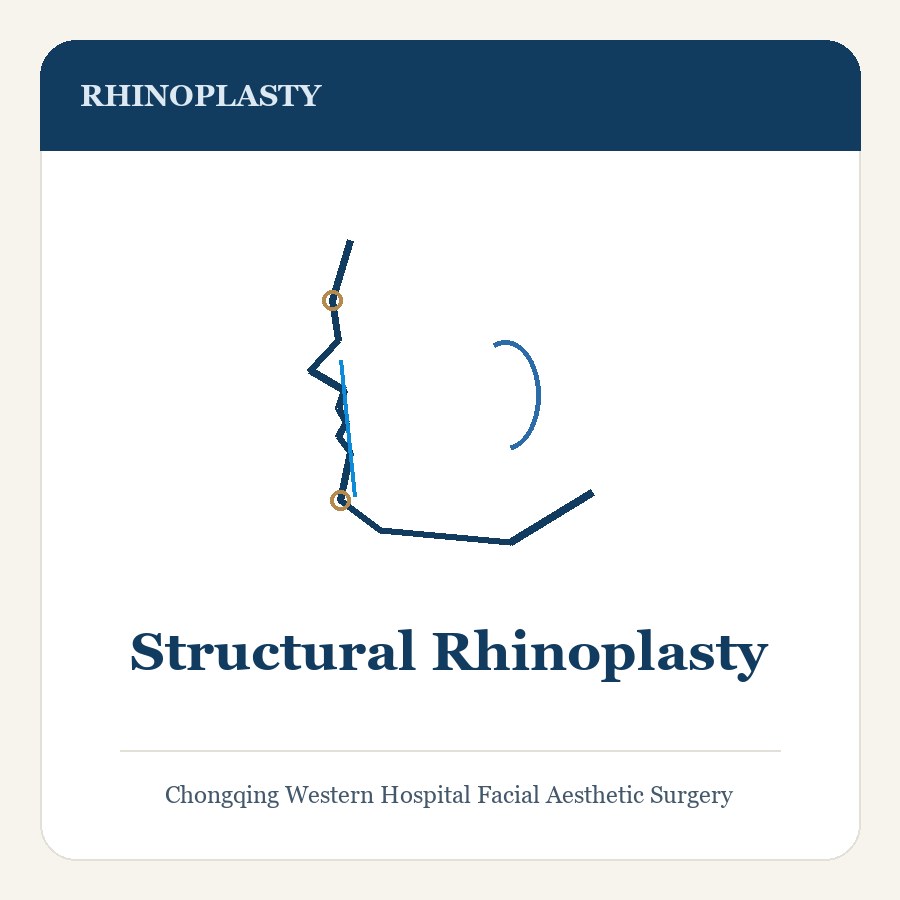
In short. Structural rhinoplasty rebuilds the nasal framework with the patient's own cartilage instead of mainly removing bone and cartilage. It suits weak, flat, or short noses and revisions where support was lost. Reduction suits a strong nose that is simply large. The signature move is a septal extension graft controlling tip position and length. Results are stable but the tip feels firm for months.
Key points
- Structural adds support; reduction removes tissue.
- Weak tip support is the main indication.
- A septal extension graft controls projection and length.
- It takes longer, needs more graft, and swells longer.
- Graft-specific risks: warping, resorption, visible edges.
Build or carve?
| Reduction | Structural | |
|---|---|---|
| Action | Removes hump, trims cartilage, narrows bone | Adds cartilage grafts |
| Suits | Strong nose that is too large | Weak, flat, short nose; revision |
| Framework | Relies on remaining support | Engineered support |
| Operating time | Shorter | Longer, often 3+ hours |
| Swelling | Less | More, months |
| Main risks | Removal-related | Warping, resorption, visible edges |
Many operations blend both: reduce the hump, then rebuild the tip support.
Why does the tip need support?
The tip behaves like a tent: its shape depends on the strength of the poles (tip cartilages) and the central post (septum) more than on the fabric (skin). Reduction cuts and reshapes the poles, which works when they are already strong. When they are weak, cutting further only weakens them. The structural answer is to add a stronger framework and let the skin drape over it.
What is a septal extension graft?
The signature manoeuvre extends the septum with a cartilage plate fixed at its end, to which the tip cartilages are anchored. This controls projection, rotation, and length with a precision sutures alone cannot achieve, and it is the usual way to lengthen a short nose. When septal cartilage is insufficient, rib cartilage substitutes at the cost of a chest incision and some risk of warping.
Who is it for — and not for?
It suits weak tip support, low projection, short length, thick skin that needs a firm framework, and most revision noses. It is unnecessary for a large, strong nose that simply needs reduction, where adding grafts would make it bigger.
What can it achieve?
It can create projection, definition, and length that reduction never could, and hold them against thick skin and time. It cannot make the skin envelope smaller than it is; a large skin sleeve over a new framework can look full for a year before it shrinks to fit. It cannot guarantee that carved cartilage will never warp.
What is recovery like?
A splint for a week, desk work at two weeks, and a firm, stiff-feeling tip for months. Meaningful swelling persists three to six months; the final result is judged at a year.
When should a surgical review happen?
- The tip becomes progressively twisted, or a hard graft edge becomes visible or painful.
- Chest pain, breathlessness, or a wound problem after rib harvest.
- Considering major structural surgery while smoking or with healing disorders.
Sources
Internal links
Frequently asked questions
How does structural rhinoplasty differ from reduction rhinoplasty?
Reduction rhinoplasty removes a hump, trims cartilage and narrows bones, suiting noses whose support is already adequate. Structural rhinoplasty adds cartilage grafts to rebuild the framework, which suits weak, flat or short noses and revisions where support was lost. Many operations blend both.
Why does the tip feel firm and stiff for so long?
Rigidity is the price of support, and it softens gradually. Expect a splint for a week, desk work at two weeks, meaningful swelling for three to six months, and a stiff-feeling tip for months. The final result is judged at a year.
What graft-specific risks does structural surgery add?
Beyond the usual rhinoplasty risks, it adds warping, resorption, visibility of a graft edge through thin skin, and asymmetry as swelling settles unevenly. Donor sites carry their own small risks. A minority of patients need a touch-up, usually not considered before twelve months.
Risks & Limitations
- Bruising and swelling lasting weeks; after bone surgery, months pass before the final result is visible.
- Scars are permanent. They mature and fade over 6–12 months but never disappear.
- Numbness or altered sensation, which may be temporary or, after bone or nerve work, lasting.
- Asymmetry, under-correction or over-correction; final assessment is made at 6–12 months.
- Infection, bleeding or haematoma, which may need drainage or antibiotics.
- Breathing changes after nasal surgery, which may be temporary or require further treatment.
- Revision surgery carries higher risk and is less predictable than a first operation.
When to Seek Care
- Difficulty breathing or shortness of breath — seek emergency care immediately.
- Rapidly expanding swelling, or a tense, painful, tight area.
- Fever above 38 °C, spreading redness, warmth or pus.
- Bleeding that does not stop with gentle pressure.
- Any sudden change in vision after facial surgery or a facial injection.
References & Further Reading
- American Society of Plastic Surgeons (ASPS) — procedure and safety guidance
- International Society of Aesthetic Plastic Surgery (ISAPS)
- National Institute for Health and Care Excellence (NICE, UK) — relevant guidance
- Cochrane Library — systematic reviews in facial plastic surgery
This page is patient education, not medical advice, and it does not cite individual studies. Discuss your own case with a qualified clinician. To arrange an assessment at Chongqing West District Hospital, see Contact & Consultation.