
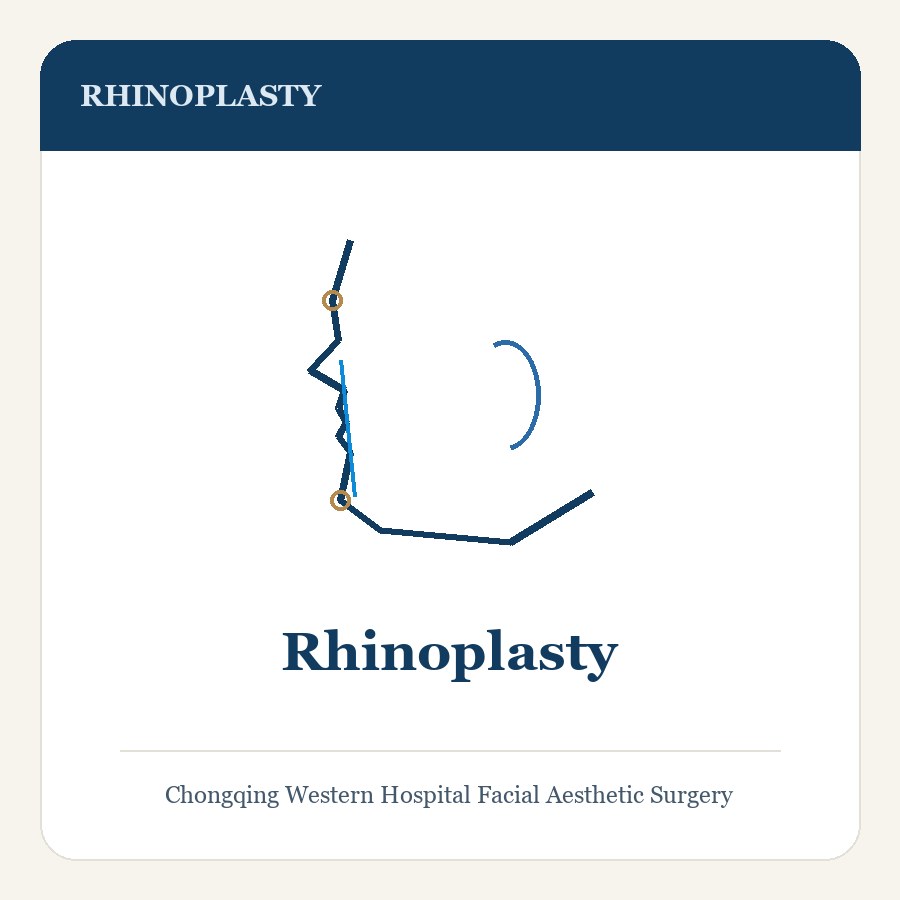
In short. Rhinoplasty reshapes the nose — bridge, tip, and sometimes the airway — by operating on bone, cartilage, and skin. Reduction removes tissue; structural surgery rebuilds support with cartilage grafts. Open access adds a small columellar scar and is preferred for tip work and revision; closed access hides all incisions inside the nostrils. Final judgement waits six to twelve months.
Key points
- Reduction removes; structural rebuilds support.
- Open access suits tip work, grafting, and revision.
- Closed access leaves no external scar.
- Thick skin cannot be thinned; symmetry is not millimetre-perfect.
- Revision is more complex than the first operation.
Reduction or structural?
| Reduction rhinoplasty | Structural rhinoplasty | |
|---|---|---|
| Action | Removes tissue | Rebuilds support |
| Suits | Nose simply too large | Needs projection, definition, raised bridge |
| Common in | Hump, wide base | East Asian anatomy, revision |
| Material | Often none | Cartilage grafts |
| Risk profile | Removal-related | Graft-related |
Open or closed?
| Closed | Open | |
|---|---|---|
| Incisions | Inside nostrils | Plus columellar incision |
| External scar | None | Faint but permanent |
| Best for | Modest changes | Tip work, grafting, revision |
| View of framework | Limited | Direct |
Who is it for — and not for?
Good candidates are adults whose facial growth is complete, in reasonable general health, who can describe a specific concern rather than a vague wish for a different face. Surgery is deferred for active smokers until they quit, and for uncontrolled diabetes, bleeding disorders, or healing problems. A nose expected to fix self-esteem, a career, or a relationship is a warning sign, not an indication.
What can surgery achieve?
It can raise or lower a bridge, refine and support a tip, narrow a base, straighten a deviation, and improve breathing. It cannot thin thick skin, guarantee millimetre symmetry, or make one person's nose belong to another face. Judgement waits six to twelve months, because swelling distorts everything before that.
What is recovery like?
An external splint is worn for about a week, and most return to desk work in ten to fourteen days. Bruising under the eyes fades over two weeks. Strenuous exercise, glasses on the bridge, and contact sports are restricted for roughly six weeks. Residual tip swelling can persist for a year, especially in thicker skin.
What are the risks?
Scars are hidden or minimal but permanent. Recognised complications include bleeding, infection, asymmetry, residual deviation, breathing difficulty, skin irregularities, and implant-related problems such as movement, contracture, or extrusion. Around five to fifteen percent of patients eventually choose revision, which is more complex than the first operation.
When should a surgical review happen?
- Breathing worsens after injury or previous surgery, or one side becomes blocked.
- An implant edge becomes visible, the skin thins or reddens, or pain and discharge appear.
- Pregnancy, active smoking, an untreated bleeding disorder, or uncontrolled diabetes.
Sources
Internal links
Frequently asked questions
Am I a suitable candidate for rhinoplasty?
Good candidates are adults whose facial growth is complete, who are in reasonable general health, and who can describe a specific concern rather than a vague wish for a different face. Surgery is deferred for active smokers and for people with uncontrolled diabetes, bleeding disorders or healing problems.
How long before the final result can be judged?
An external splint is worn for about a week and most people return to desk work in ten to fourteen days. Bruising under the eyes fades over two weeks, but judgement of the final result waits six to twelve months, because swelling distorts everything before that.
Will rhinoplasty leave a visible scar?
In a closed rhinoplasty all incisions hide inside the nostrils and leave no external scar. An open rhinoplasty adds a small incision across the columella, which usually fades to a faint line but is permanent. All rhinoplasty scars are permanent, even when inconspicuous.
Risks & Limitations
- Bruising and swelling lasting weeks; after bone surgery, months pass before the final result is visible.
- Scars are permanent. They mature and fade over 6–12 months but never disappear.
- Numbness or altered sensation, which may be temporary or, after bone or nerve work, lasting.
- Asymmetry, under-correction or over-correction; final assessment is made at 6–12 months.
- Infection, bleeding or haematoma, which may need drainage or antibiotics.
- Breathing changes after nasal surgery, which may be temporary or require further treatment.
- Revision surgery carries higher risk and is less predictable than a first operation.
When to Seek Care
- Difficulty breathing or shortness of breath — seek emergency care immediately.
- Rapidly expanding swelling, or a tense, painful, tight area.
- Fever above 38 °C, spreading redness, warmth or pus.
- Bleeding that does not stop with gentle pressure.
- Any sudden change in vision after facial surgery or a facial injection.
References & Further Reading
- American Society of Plastic Surgeons (ASPS) — procedure and safety guidance
- International Society of Aesthetic Plastic Surgery (ISAPS)
- National Institute for Health and Care Excellence (NICE, UK) — relevant guidance
- Cochrane Library — systematic reviews in facial plastic surgery
This page is patient education, not medical advice, and it does not cite individual studies. Discuss your own case with a qualified clinician. To arrange an assessment at Chongqing West District Hospital, see Contact & Consultation.