
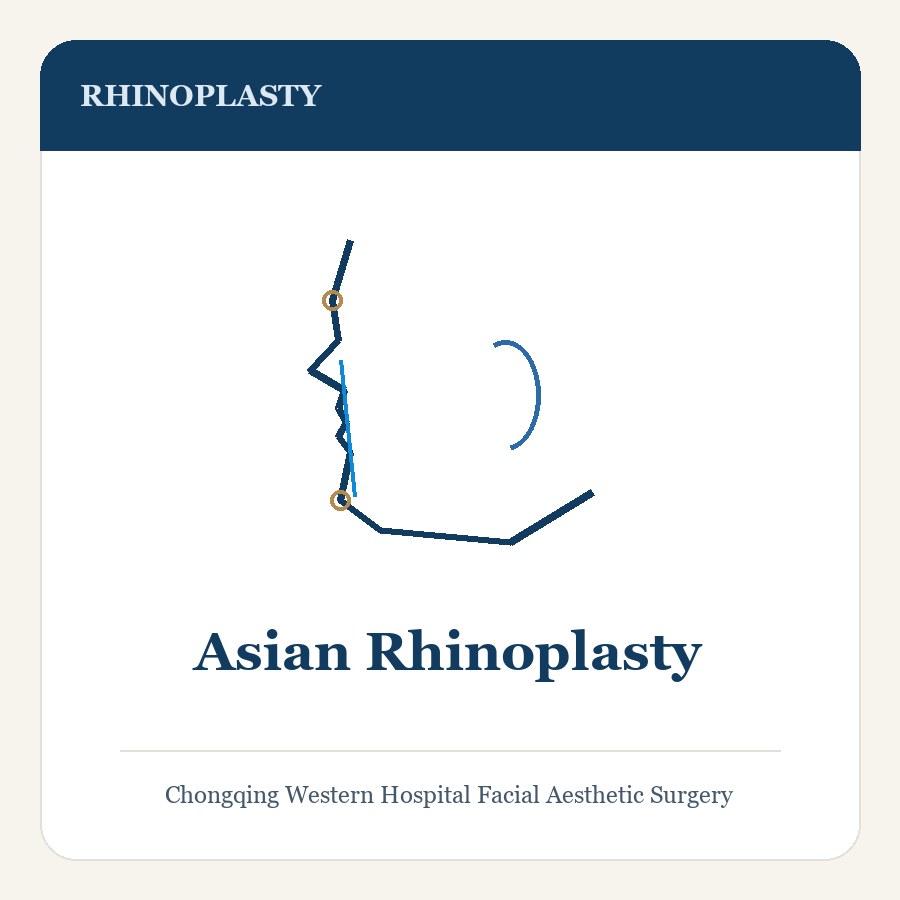
In short. Asian rhinoplasty usually means building support rather than removing tissue: a higher bridge, a more defined tip, a narrower base, against thicker skin and weaker natural cartilage. Implants raise the bridge predictably but carry movement, contracture, thinning, and extrusion risks. The tip should be supported by the patient's own cartilage, never pushed up by an implant.
Key points
- Most requests are augmentation tasks, not reduction.
- Thick skin is a hard limit on visible detail.
- Implants suit the bridge; cartilage supports the tip.
- Over-projecting the tip to defeat thick skin causes trouble.
- Tip swelling can take twelve months or more to settle.
Why augmentation rather than reduction?
The East Asian nose often has a lower, wider bony bridge, a shorter septum with less cartilage for grafting, weaker and smaller tip cartilages, and a thicker, more sebaceous skin envelope. The usual requests — a higher bridge, a more defined and projected tip, a narrower base — are building tasks, not removal tasks.
| Implant | Autologous cartilage | |
|---|---|---|
| Best use | Bridge | Tip and structural support |
| Predictability | High | Good, with carving skill |
| Movement | Can move in pocket | None |
| Contracture / extrusion | Recognised risks | None |
| Donor site | No | Septum, ear, or rib |
| Main trade-off | Long-term device risk | Donor-site surgery; rib warping |
Who is it for — and not for?
It suits adults bothered by a flat bridge, an undefined tip, or a wide base, who want refinement that still reads as their own face. It does not suit those chasing an imported ideal that fights their proportions, nor those expecting thick skin to show fine cartilage detail — skin thickness is a hard physical limit.
Open or closed?
Most augmentation rhinoplasty in thicker skin is performed through the open approach, because precise graft placement matters more than a hidden scar. The columellar incision fades well in most patients. Surgery is usually under general anaesthesia, often combined with cartilage harvest from the septum or ear.
What can surgery achieve?
It can reliably raise the bridge, lengthen and project the tip modestly, and refine the base. It cannot make thick skin delicate: the sharper the framework underneath, the more the skin blurs the detail, and aggressive over-projection is exactly how tips get into trouble. Expect improvement in balance and profile, not a different ethnicity of nose.
How long does recovery take?
The splint stays about a week; social downtime is typically two weeks. Tip swelling in thick skin is the slowest part of healing, and final definition may not declare itself for twelve months or more. Judging earlier leads to unnecessary anxiety and premature revision requests.
What are the risks?
Scars hide inside the nose and in the columellar crease but are permanent. Specific complications include implant mobility or capsular contracture, skin thinning or redness over an implant edge, extrusion (rare but serious), graft visibility, asymmetry, and conspicuous base scars in some skin types. Revision is harder than primary surgery.
When should a surgical review happen?
- Skin over the bridge or tip becomes red, shiny, thin, or painful, or an implant edge becomes visible.
- Fever, swelling, or discharge after augmentation, even years later.
- A plan that extends an implant into the tip, or surgery while smoking, pregnant, or with uncontrolled disease.
Sources
Internal links
Frequently asked questions
Why does this usually mean augmentation rather than reduction?
The East Asian nose often has a lower, wider bony bridge, a shorter septum with less cartilage available for grafting, weaker tip cartilages and a thicker skin envelope. The usual requests, a higher bridge and a more defined tip, are therefore building tasks rather than removal tasks.
Can surgery make thick nasal skin look more delicate?
No. Skin thickness is a hard physical limit that no technique removes. The sharper the framework underneath, the more thick skin blurs the detail, and over-projecting the tip to defeat that blurring is exactly how tips get into trouble.
How long does tip swelling last in thicker skin?
The splint stays about a week and social downtime is typically two weeks. Tip swelling in thick skin is the slowest part of healing, and the final definition may not declare itself for twelve months or more. Judging the result earlier leads to unnecessary anxiety and premature revision requests.
Risks & Limitations
- Bruising and swelling lasting weeks; after bone surgery, months pass before the final result is visible.
- Scars are permanent. They mature and fade over 6–12 months but never disappear.
- Numbness or altered sensation, which may be temporary or, after bone or nerve work, lasting.
- Asymmetry, under-correction or over-correction; final assessment is made at 6–12 months.
- Infection, bleeding or haematoma, which may need drainage or antibiotics.
- Breathing changes after nasal surgery, which may be temporary or require further treatment.
- Revision surgery carries higher risk and is less predictable than a first operation.
When to Seek Care
- Difficulty breathing or shortness of breath — seek emergency care immediately.
- Rapidly expanding swelling, or a tense, painful, tight area.
- Fever above 38 °C, spreading redness, warmth or pus.
- Bleeding that does not stop with gentle pressure.
- Any sudden change in vision after facial surgery or a facial injection.
References & Further Reading
- American Society of Plastic Surgeons (ASPS) — procedure and safety guidance
- International Society of Aesthetic Plastic Surgery (ISAPS)
- National Institute for Health and Care Excellence (NICE, UK) — relevant guidance
- Cochrane Library — systematic reviews in facial plastic surgery
This page is patient education, not medical advice, and it does not cite individual studies. Discuss your own case with a qualified clinician. To arrange an assessment at Chongqing West District Hospital, see Contact & Consultation.