
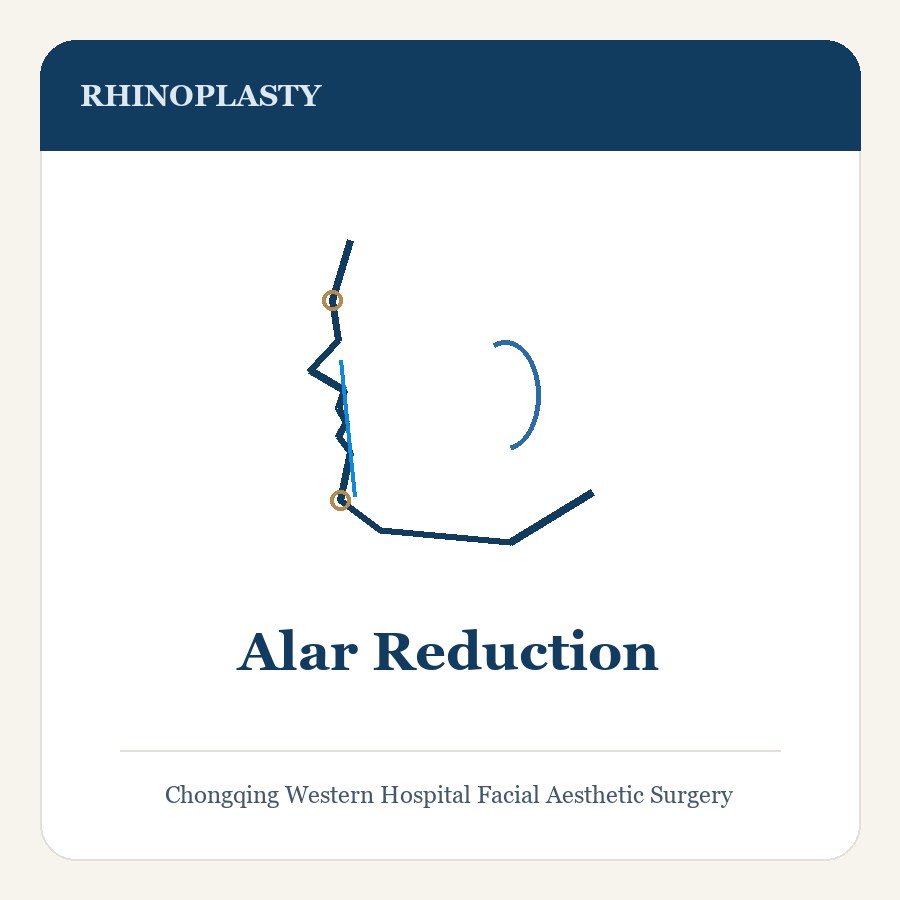
In short. Narrowing wide nostrils and a broad nasal base: where the scars sit, how much can safely be removed, and why conservative planning protects the airway.
Key points
- A wedge excision at the outer nostril base (the Weir technique) reduces flare and base width, hiding its scar in the crease with the cheek.
- A nostril sill excision narrows the floor of the opening when the base is wide but flare is not.
- An internal rim excision reduces a large nostril opening without touching the outer crease.
Alar reduction narrows the width of the nostrils and the nasal base — the feature that most determines whether a nose looks wide or refined from the front. It is a short operation measured in millimeters, but its planning is unforgiving: tissue removed from the nostril rim cannot be put back, and the difference between refined and pinched is small.
The anatomy and the aesthetic question
Three distinct features create width: the width of the base where the nostrils meet the face, the outward flare of the nostril rims (most visible when smiling), and the size of the nostril openings themselves. Each has its own surgical remedy, and confusing them leads to the wrong excision in the wrong place. Assessment measures base width against the distance between the inner corners of the eyes, the classical proportional reference.
Who it suits — and who it does not
It suits people whose base or flare is genuinely wide for their face, often alongside thicker soft tissue. It does not suit a nose that merely appears wide because the bridge is low — raising the bridge frequently narrows the perceived base without touching it, which is why this operation is sometimes deferred until after augmentation. Normal candidacy rules apply: adult, healthy, non-smoking or quitting, and realistic about what millimeters can do.
The options compared
Three excisions, one principle: restraint
A wedge excision at the outer nostril base (the Weir technique) reduces flare and base width, hiding its scar in the crease with the cheek. A nostril sill excision narrows the floor of the opening when the base is wide but flare is not. An internal rim excision reduces a large nostril opening without touching the outer crease. They are frequently combined in small doses. The governing principle is conservative removal: over-resection pinches the rim, flattens the natural curve of the nostril, narrows the airway, and is one of the hardest rhinoplasty errors to repair.
Incisions and anesthesia
Incisions lie in the crease between nostril and cheek, occasionally extending a few millimeters onto the nostril floor, and are closed in fine sutures. The operation takes under an hour, usually under local anesthesia with sedation, and patients go home the same day. It is often performed as the final step of a broader rhinoplasty, after the new framework's effect on width can be judged.
What surgery can and cannot achieve
It reliably reduces base width and flare by a planned amount, and done well it reads as a nose that fits the face rather than an operated one. It cannot thin thick skin, narrow the bony upper nose, or correct asymmetry caused by the septum or tip — those are separate problems. Perfect symmetry between two naturally asymmetric nostrils is an aspiration, not a promise.
Recovery and downtime
There is no splint; sutures come out at five to seven days. Swelling and bruising are modest, and most people return to work within days. The crease scars are pink for some weeks and then fade over six to twelve months; like all scars they are permanent, and thicker or more pigmented skin can leave them more visible for longer.
Scars, complications, and revision
Complications are uncommon but characteristic: asymmetry between the two sides, a visible or notched scar at the rim, over-resection with a pinched contour, and airway narrowing. Because removal is irreversible, revision of an over-narrowed nostril usually requires grafting or flap reconstruction — a far larger undertaking than the original excision — which is the strongest argument for conservative first surgery.
Preparation and long-term follow-up
Planning reviews frontal and basal photographs together and marks the excision with the patient upright. Smoking and blood-thinning supplements are stopped as advised. Follow-up tracks scar maturation for a year; any thought of further narrowing waits until the scars and swelling have fully declared themselves.
Arrange a surgical review if
- Breathing through one or both nostrils worsens after surgery, or the rim looks progressively pinched as swelling settles.
- A wound in the crease separates, bleeds repeatedly, or shows spreading redness or discharge in the first weeks.
- You are considering excision while pregnant, actively smoking, or with poorly controlled diabetes or a keloid tendency — these change the plan.
Frequently asked questions
How much nostril width can safely be removed?
The governing principle is conservative removal. Over-resection pinches the rim, flattens the natural curve of the nostril, narrows the airway and is one of the hardest rhinoplasty errors to repair, because tissue removed from the rim cannot be put back. Millimetres are the unit of planning here.
Where are the scars placed?
Incisions lie in the crease between the nostril and the cheek, occasionally extending a few millimetres onto the nostril floor, and are closed with fine sutures. The crease scars are pink for some weeks and then fade over six to twelve months, but like all scars they are permanent.
My nose looks wide because my bridge is low. Is alar reduction the answer?
Not necessarily. Raising the bridge frequently narrows the perceived base without touching it, which is why alar reduction is sometimes deferred until after augmentation. The operation suits a base or flare that is genuinely wide for the face, measured against the distance between the inner corners of the eyes.
Risks & Limitations
- Bruising and swelling lasting weeks; after bone surgery, months pass before the final result is visible.
- Scars are permanent. They mature and fade over 6–12 months but never disappear.
- Numbness or altered sensation, which may be temporary or, after bone or nerve work, lasting.
- Asymmetry, under-correction or over-correction; final assessment is made at 6–12 months.
- Infection, bleeding or haematoma, which may need drainage or antibiotics.
- Breathing changes after nasal surgery, which may be temporary or require further treatment.
- Revision surgery carries higher risk and is less predictable than a first operation.
When to Seek Care
- Difficulty breathing or shortness of breath — seek emergency care immediately.
- Rapidly expanding swelling, or a tense, painful, tight area.
- Fever above 38 °C, spreading redness, warmth or pus.
- Bleeding that does not stop with gentle pressure.
- Any sudden change in vision after facial surgery or a facial injection.
References & Further Reading
- American Society of Plastic Surgeons (ASPS) — procedure and safety guidance
- International Society of Aesthetic Plastic Surgery (ISAPS)
- National Institute for Health and Care Excellence (NICE, UK) — relevant guidance
- Cochrane Library — systematic reviews in facial plastic surgery
This page is patient education, not medical advice, and it does not cite individual studies. Discuss your own case with a qualified clinician. To arrange an assessment at Chongqing West District Hospital, see Contact & Consultation.