
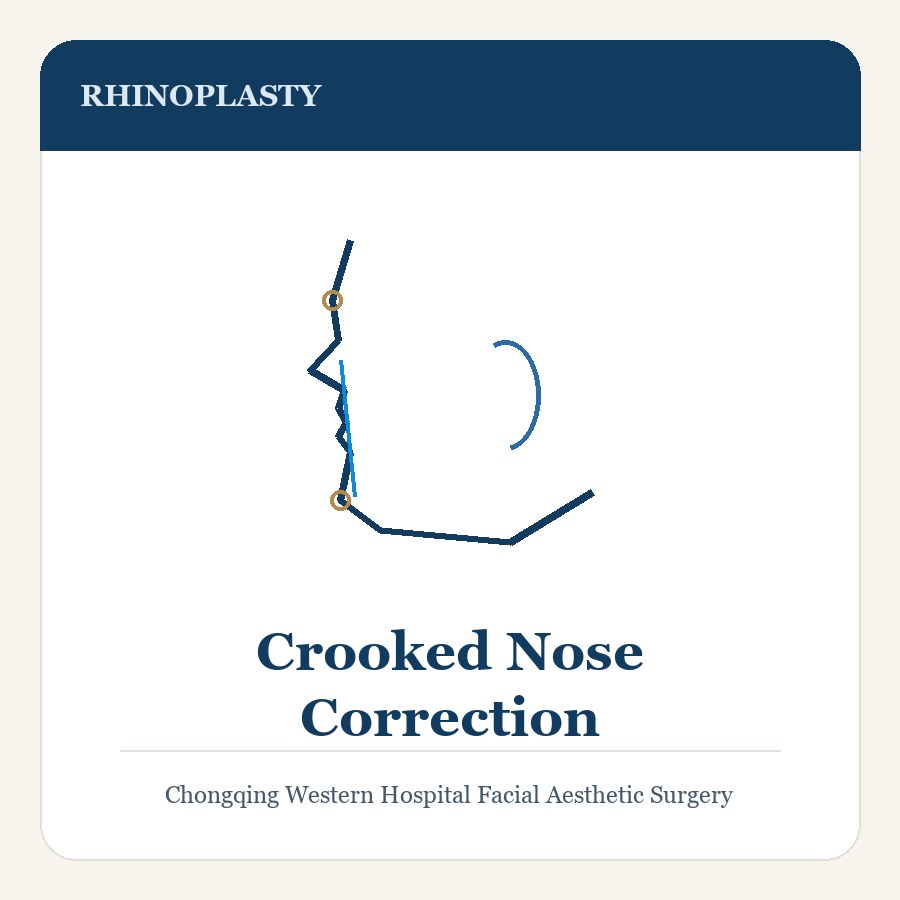
In short. Straightening a deviated nose: the septal, bony, and cartilaginous components, combining breathing and appearance, and the honest risk of recurrence.
Key points
- Camouflage adds cartilage grafts to the concave side to disguise the deviation — simpler, but it leaves the crooked framework and the airway obstruction untouched.
- True correction straightens the septum (scoring, resection, or extracorporeal reconstruction of a severely bent septum), repositions the bones with controlled fractures called osteotomies, and re-centers the tip cartilages on the new midline, often with spreader grafts that both straighten the mid-vault and hold the airway open.
- Correction is the larger operation, but camouflage alone in a genuinely deviated nose tends to disappoint.
A crooked nose is not one problem but three stacked together: a deviated septum inside, crooked nasal bones above, and twisted tip and mid-vault cartilages below. Correcting it means rebuilding the nose's central alignment from the inside out, and it is among the most technically demanding operations in rhinoplasty because every layer must be addressed or the deviation returns.
The anatomy and the aesthetic question
Most crooked noses follow trauma, sometimes in childhood and forgotten; others are developmental. The septum — the wall dividing the airway — is usually the engine of the deformity: when it bends, it pushes the cartilages and sometimes the bones with it. Because the septum is also the airway's structural wall, the functional and aesthetic problems are the same problem, and the best operations treat both in one plan.
Who it suits — and who it does not
It suits adults with visible deviation, one-sided obstruction, or both, whether from injury or development. It demands realistic expectations: a moderately crooked nose can usually be made substantially straighter, but a guarantee of ruler-straight symmetry is not honest — cartilage has memory, faces are naturally asymmetric, and some drift back is a recognized outcome. Uncontrolled bleeding disorders and active smoking defer surgery as usual.
The options compared
Rebuild the midline, not just camouflage the bend
Two philosophies exist. Camouflage adds cartilage grafts to the concave side to disguise the deviation — simpler, but it leaves the crooked framework and the airway obstruction untouched. True correction straightens the septum (scoring, resection, or extracorporeal reconstruction of a severely bent septum), repositions the bones with controlled fractures called osteotomies, and re-centers the tip cartilages on the new midline, often with spreader grafts that both straighten the mid-vault and hold the airway open. Correction is the larger operation, but camouflage alone in a genuinely deviated nose tends to disappoint. Combined functional and aesthetic correction in one anaesthetic is standard practice.
Incisions and anesthesia
The open approach is usual because the deviated framework must be seen and measured. Osteotomies are made through small internal or percutaneous incisions. Surgery is performed under general anesthesia with tertiary-hospital airway and monitoring support, and typically lasts two to three hours or more.
What surgery can and cannot achieve
It can substantially improve alignment, symmetry, and airflow, and most patients are satisfied with both. It cannot erase the memory of cartilage: some degree of recurrent deviation occurs in a meaningful minority, more so after severe trauma. Final judgement waits a full year, because asymmetric swelling can mimic recurrence for months.
Recovery and downtime
A splint is worn one to two weeks to hold the repositioned bones; internal splints may support the septum for a similar period. Bruising around the eyes is normal for two weeks, and desk work resumes around then. Breathing typically improves once internal swelling settles, over several weeks. Contact sports are off for at least six weeks.
Scars, complications, and recurrence
Scars are internal plus the small columellar line. Complications include septal hematoma and perforation, persistent or recurrent deviation, mid-vault collapse if support was lost, synechiae (internal adhesions), and residual asymmetry. Recurrence is discussed before surgery, not after: severe deviations carry a published recurrence risk that no technique eliminates, and a secondary procedure is sometimes part of the long-term picture.
Preparation and long-term follow-up
Assessment includes internal nasal examination, photographic analysis of the deviation vector, and CT imaging when fracture patterns or sinus issues are suspected. Follow-up over twelve months tracks both breathing and alignment, since late drift is exactly what needs catching.
Arrange a surgical review if
- One-sided obstruction worsens, or new deviation follows a fresh injury — early septal hematoma after trauma is time-sensitive.
- Nosebleeds recur, whistling develops with breathing, or crusting and pain persist after surgery — possible perforation or adhesions.
- Deviation visibly returns within the first year — early review distinguishes swelling from true recurrence and plans accordingly.
Frequently asked questions
Can a crooked nose be made perfectly straight?
No honest surgeon promises that. A moderately crooked nose can usually be made substantially straighter, but cartilage has memory, faces are naturally asymmetric, and some drift back is a recognised outcome. Final judgement waits a full year, because asymmetric swelling can mimic recurrence for months.
Will straightening the nose also improve my breathing?
It should be planned that way. The septum is both the engine of the deformity and the structural wall of the airway, so the functional and the aesthetic problems are the same problem. The best operations treat both in one plan, often using spreader grafts to hold the mid-vault open.
What is the difference between camouflage and true correction?
Camouflage adds cartilage grafts to the concave side to disguise the bend, leaving the crooked framework and the airway obstruction untouched. True correction straightens the septum, repositions the bones with controlled fractures and re-centres the tip cartilages on the new midline. It is the larger operation.
Risks & Limitations
- Bruising and swelling lasting weeks; after bone surgery, months pass before the final result is visible.
- Scars are permanent. They mature and fade over 6–12 months but never disappear.
- Numbness or altered sensation, which may be temporary or, after bone or nerve work, lasting.
- Asymmetry, under-correction or over-correction; final assessment is made at 6–12 months.
- Infection, bleeding or haematoma, which may need drainage or antibiotics.
- Breathing changes after nasal surgery, which may be temporary or require further treatment.
- Revision surgery carries higher risk and is less predictable than a first operation.
When to Seek Care
- Difficulty breathing or shortness of breath — seek emergency care immediately.
- Rapidly expanding swelling, or a tense, painful, tight area.
- Fever above 38 °C, spreading redness, warmth or pus.
- Bleeding that does not stop with gentle pressure.
- Any sudden change in vision after facial surgery or a facial injection.
References & Further Reading
- American Society of Plastic Surgeons (ASPS) — procedure and safety guidance
- International Society of Aesthetic Plastic Surgery (ISAPS)
- National Institute for Health and Care Excellence (NICE, UK) — relevant guidance
- Cochrane Library — systematic reviews in facial plastic surgery
This page is patient education, not medical advice, and it does not cite individual studies. Discuss your own case with a qualified clinician. To arrange an assessment at Chongqing West District Hospital, see Contact & Consultation.