
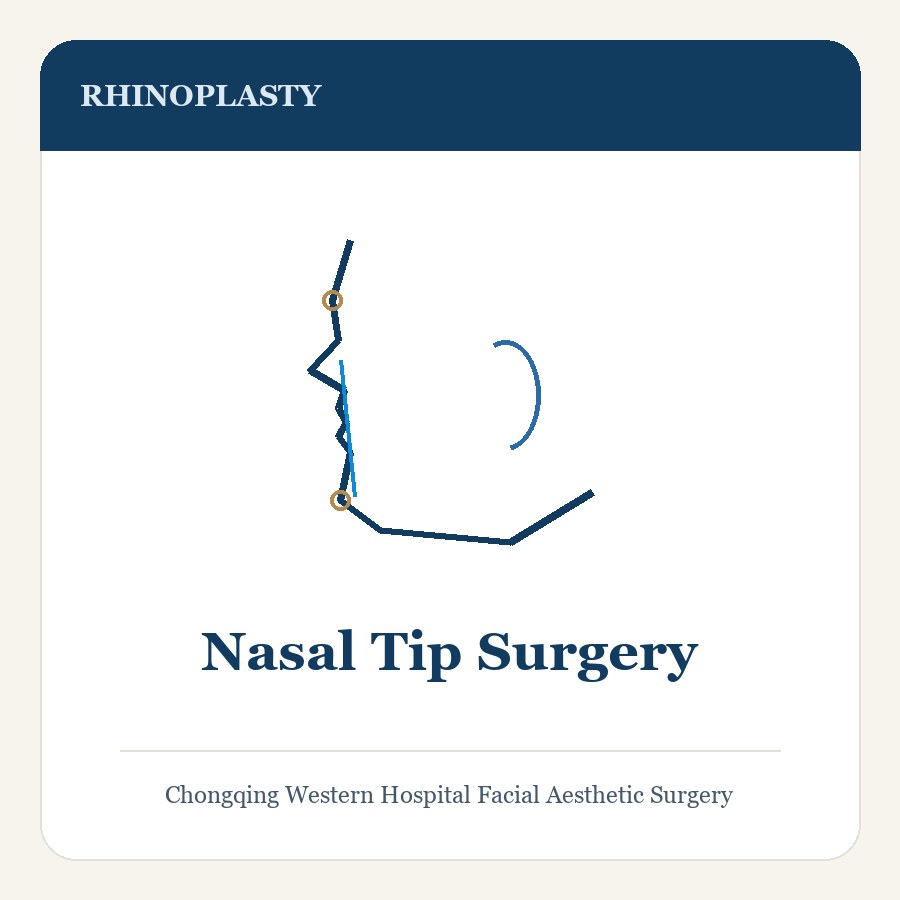
In short. Nasal tip surgery reshapes the lower third of the nose, its definition, projection and rotation, by re-engineering the paired cartilages that form the tip. The skin envelope sets a ceiling on refinement, so thick skin limits how sharp a result can be, and the tip is judged at twelve months or beyond.
Key points
- Nasal tip surgery reshapes the lower third by re-engineering the paired tip cartilages.
- Sutures reposition existing cartilage; grafts add support where the native cartilage is weak.
- Thin skin shows every refinement and every imperfection; thick skin blurs both.
- Thick skin sets a ceiling that cartilage work cannot exceed, however refined the framework.
- The tip is the last part of the nose to settle, at twelve months or beyond.
What does nasal tip surgery change?
Nasal tip surgery reshapes the lower third of the nose, its definition, projection and rotation, by re-engineering the paired cartilages that form it. It is the most detail-sensitive part of rhinoplasty: differences of a millimetre are visible, and the quality of the result depends as much on the skin as on the cartilage work beneath it.
The anatomy and the aesthetic question
The tip is formed by two arched cartilages whose shape, strength and spacing determine whether the tip reads as defined or bulbous, projected or flat, upturned or drooping. Skin thickness then acts as a filter: thin skin shows every refinement and every imperfection, while thick skin blurs both. Aesthetic analysis therefore measures the cartilage framework and the skin envelope separately, because the plan must address both.
Who it suits, and who it does not
It suits adults bothered by a bulbous, drooping, asymmetric or under-projected tip whose bridge needs little or no work, and it is often one component of a full rhinoplasty. It does not suit unrealistic expectations of fine, sharp definition under very thick skin: the skin sets a ceiling that cartilage work cannot exceed. General health, non-smoking and maturity of facial growth are prerequisites.
Sutures reshape, grafts support
Two toolkits exist and are usually combined. Suture techniques reposition and narrow the existing tip cartilages; they are conservative, reversible in principle, and ideal when the cartilages are reasonably strong and only their arrangement is wrong. Cartilage grafts add structure where the native cartilage is weak: a columellar strut or septal extension graft for support and projection, small shield or cap grafts for definition. Sutures reshape; grafts support. A drooping, weak tip fixed with sutures alone often relapses, and a strong tip needing only narrowing rarely needs grafts at all. The choice is made from the cartilage's actual strength, assessed at examination and confirmed at surgery.
| Approach | What it does | When it is chosen | What it does not do |
|---|---|---|---|
| Suture techniques | Reposition and narrow the existing tip cartilages | Cartilages reasonably strong, only the arrangement wrong | Support a weak tip on its own |
| Columellar strut or septal extension graft | Add support and projection | The native cartilage is weak | Exceed the ceiling set by thick skin |
| Shield or cap grafts | Add definition | Small grafts are needed at the tip | Exceed the ceiling set by thick skin |
| Open approach | Direct vision and precise fixation through a columellar incision | Most meaningful tip work | Avoid a faint permanent scar |
| Closed approach | Suture refinement entirely inside the nostrils | Simple suture refinement | Direct vision for structural work |
Incisions and anaesthesia
Simple suture refinement can be done closed, entirely inside the nostrils. Most meaningful tip work uses the open approach for direct vision and precise fixation, through a small columellar incision that fades to a fine line. Anaesthesia ranges from local with sedation for minor work to general anaesthesia for structural grafting.
What surgery can and cannot achieve
It can narrow a broad tip, correct asymmetry, lift rotation and add lasting projection. It cannot create sharp definition under thick skin no matter how refined the framework, and it cannot be judged early.
Why is the result judged over a year?
External splinting lasts about a week, and most patients are socially presentable in two weeks. Tip swelling is stubborn and fluctuates, worse in the morning and better by evening, for months. Firmness of the tip is normal and softens gradually over the year. The tip is the last part of the nose to declare its final shape, at twelve months or beyond, so a result that looks slightly full at three months is often exactly on course. Consultation includes frontal and profile photographic analysis, a skin-thickness assessment and a forecast calibrated to the skin envelope, and follow-up photographs at defined intervals over a year let surgeon and patient judge the same evolving object rather than comparing memories.
Scars, complications and revision
The columellar scar is usually faint but permanent. Complications include asymmetry, visible or palpable graft edges under thin skin, loss of projection if support was insufficient, over-rotation or a pinched look from over-aggressive cartilage trimming, and persistent stiffness. Small touch-ups are not rare, and revision is deliberately delayed a year so that swelling cannot masquerade as a problem.
When should a problem be reviewed?
Arrange a surgical review if:
- The tip becomes increasingly twisted, sharply asymmetric, or a firm graft edge becomes visible or tender during healing.
- Skin over the tip turns persistently red, dusky or painful in the early weeks; blood supply problems need prompt assessment.
- You are seeking sharply defined results with very thick skin, or surgery while smoking; the plan or the timing needs to change first.
Sources
- American Academy of Facial Plastic and Reconstructive Surgery: patient information on rhinoplasty and tip refinement
- NICE: interventional procedures guidance on rhinoplasty
- Cochrane Library: systematic reviews on rhinoplasty techniques
Internal links
Frequently asked questions
Can I get a sharply defined tip if my skin is thick?
No. Skin thickness sets a ceiling that cartilage work cannot exceed, so fine, sharp definition is not achievable under very thick skin no matter how refined the framework beneath. Realistic planning forecasts the result from the skin envelope as well as from the cartilage.
When are cartilage grafts needed instead of sutures alone?
Sutures reposition and narrow the existing tip cartilages, which works when they are reasonably strong and only their arrangement is wrong. Where the native cartilage is weak, grafts add support. A drooping, weak tip fixed with sutures alone often relapses, so the choice follows the cartilage strength found at examination.
Why is the tip the last part of the nose to settle?
Tip swelling is stubborn and fluctuates, worse in the morning and better by evening, for months. The tip is the last part of the nose to declare its final shape, at twelve months or beyond, so a result that looks slightly full at three months is often exactly on course.
Risks & Limitations
- Bruising and swelling lasting weeks; after bone surgery, months pass before the final result is visible.
- Scars are permanent. They mature and fade over 6–12 months but never disappear.
- Numbness or altered sensation, which may be temporary or, after bone or nerve work, lasting.
- Asymmetry, under-correction or over-correction; final assessment is made at 6–12 months.
- Infection, bleeding or haematoma, which may need drainage or antibiotics.
- Breathing changes after nasal surgery, which may be temporary or require further treatment.
- Revision surgery carries higher risk and is less predictable than a first operation.
When to Seek Care
- Difficulty breathing or shortness of breath — seek emergency care immediately.
- Rapidly expanding swelling, or a tense, painful, tight area.
- Fever above 38 °C, spreading redness, warmth or pus.
- Bleeding that does not stop with gentle pressure.
- Any sudden change in vision after facial surgery or a facial injection.
References & Further Reading
- American Society of Plastic Surgeons (ASPS) — procedure and safety guidance
- International Society of Aesthetic Plastic Surgery (ISAPS)
- National Institute for Health and Care Excellence (NICE, UK) — relevant guidance
- Cochrane Library — systematic reviews in facial plastic surgery
This page is patient education, not medical advice, and it does not cite individual studies. Discuss your own case with a qualified clinician. To arrange an assessment at Chongqing West District Hospital, see Contact & Consultation.